


Nasdaq 100 Hits Best 4-Week Rally Since 2020 As Chips Notch Record Streak: The Week On Wall Street
With the U.S.-Iran ceasefire agreement extended, Wall Street resumed the AI-driven semiconductor rally.
The Philadelphia Semiconductor Index — as tracked by the iShares PHLX Semiconductor ETF (NASDAQ:SOXX) — notched 18 straight sessions of gains, the longest winning streak on record, amid a wave of blowout earnings and analyst upgrades.
- Intel Corporation (NASDAQ:INTC) led the charge. Shares surged past levels not seen since August 2000 – at the very peak of the dot-com bubble – after the company delivered blowout first-quarter results. The stock is now up more than 80% this month alone, on pace for the best month in Intel’s history.
- Advanced Micro Devices, Inc. (NASDAQ:AMD) jumped 24.6% over the five-day stretch, pushing its month-to-date gain to 70% – the stock’s best month since January 2001.
- Texas Instruments Incorporated (NASDAQ:TXN) rallied 20% after its own strong quarterly results, its best week since April 2001.
The common thread: Al infrastructure spending is accelerating, despite the war’s disruption to supply chains.
The leaderboard in the S&P 500 this week reflected the same story — chips, capex plays, and anything tied to the Al buildout.
| Company | 5-Day Change |
| #1 Advanced Micro Devices, Inc. | +24.56% |
| #2 United Rentals, Inc. (NYSE:URI) | +22.08% |
| #3 Texas Instruments Incorporated | +20.47% |
| #4 Intel Corporation | +18.93% |
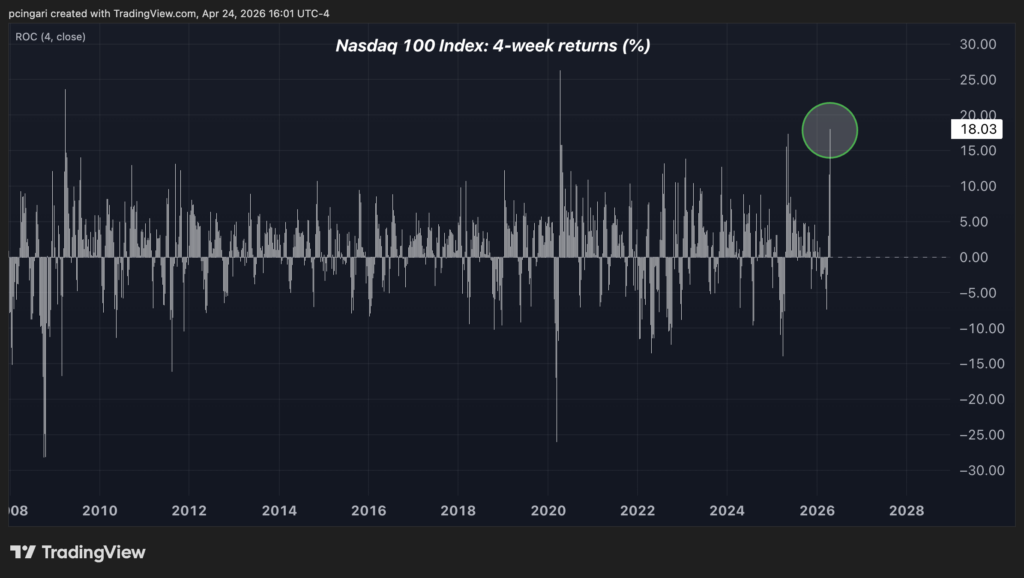
The Nasdaq 100 closed above 27,300 for the first time, notching its fourth straight week of gains.
The index has rallied 18% over the past 20 sessions — its strongest four-week run since April 2020, when markets were snapping back from the pandemic shock.
Chart: Tech Stocks’ Relief Rally Is The Best Since April 2020
The S&P 500 also notched its fourth straight week of advances, climbing 12.4% over the same stretch – its best four-week rally since May 2025.
With 88% of companies that have reported so far beating estimates — well above the 10-year average of 76% — the earnings season is providing a floor for the stock market.
Geopolitical Picture Remains Treacherous
On Monday, with the ceasefire set to expire at midnight, President Trump extended it another three weeks. U.S. special envoy Steve Witkoff and Trump’s son-in-law, Jared Kushner, are expected in Pakistan on Saturday, April 25, to negotiate with their Iranian counterparts, the White House confirmed Friday.
Oil crept back near $100 a barrel as the Strait of Hormuz remains effectively closed.
Markets shrugged — at least for now — but the damage to consumer confidence is difficult to ignore.
The University of Michigan’s final April Consumer Sentiment reading was revised slightly higher to 49.8 from an initial estimate of 47.6 — but it remains the weakest reading ever recorded.
“After the two-week cease-fire was announced and gas prices softened a touch, sentiment recovered a modest portion of its early-month losses,” said Surveys of Consumers Director Joanne Hsu.
Wall Street and Main Street are reading the same war from different pages. On trading desks, chipmakers are rewriting history.
At the pump, where the national average for regular gasoline remains nearly 40% above pre-war levels, the story is harder to spin.
Image: Shutterstock